
Build the Relationships That Matter Most at Work | 2-Minute Video
By
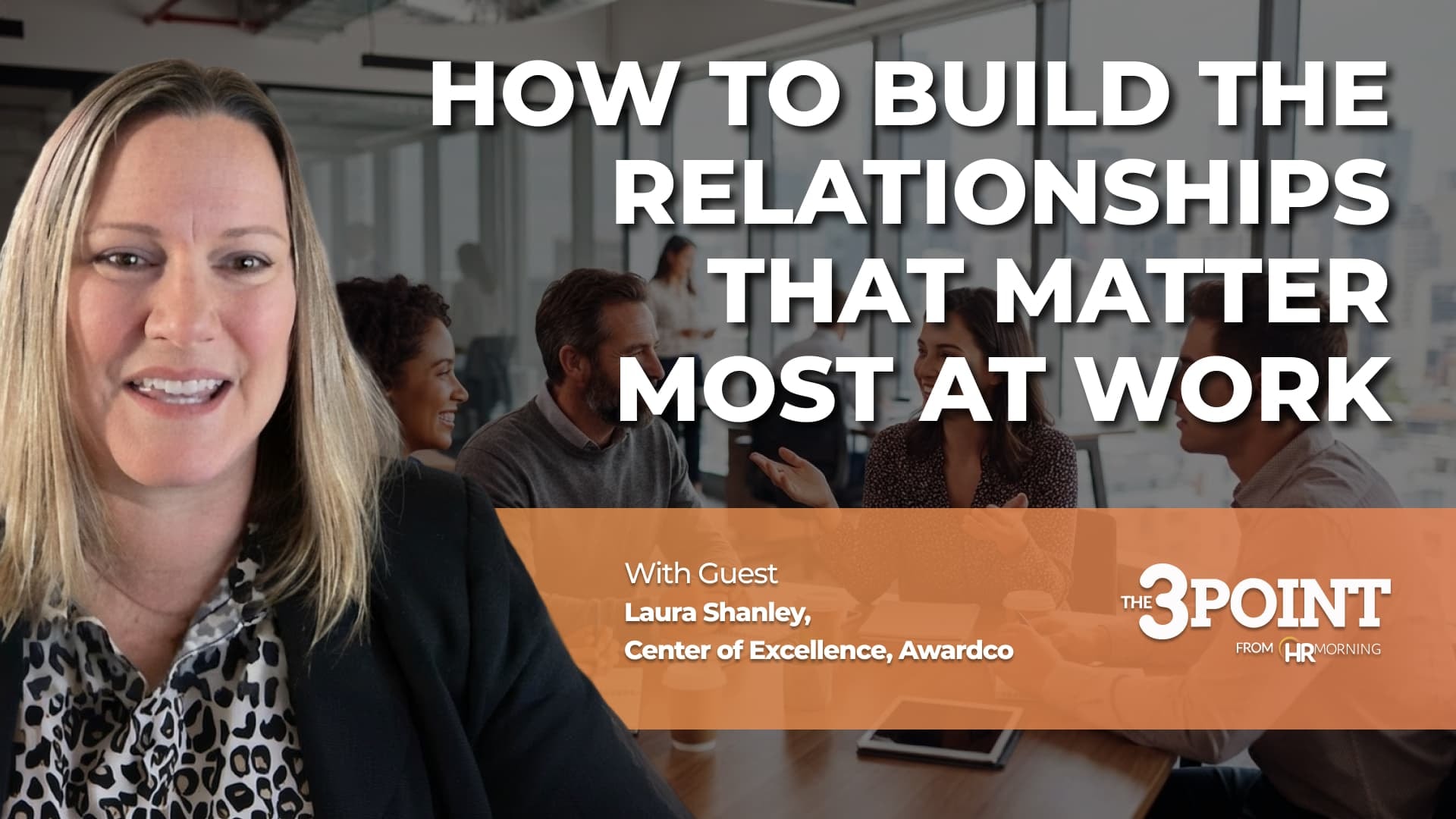
When it comes to recognition, the person who gives it is just as important as the message.
Sure, it’s important for the boss to recognize employees. But peer-to-peer recognition packs the most punch: Employee relationships matter most.
What’s Up in This Episode: Building Better Relationships
That’s based on research and observation from Awardco. In this episode of HRMorning’s 3-Point, our expert, Laura Shanley, who is at the heart of the Center of Excellence at Awardco, explains what their research found about relationships and recognition. She also gives us tips on building those important relationships.
Click, watch and listen for more details on the importance of building the right relationships to foster a great company culture.
Transcript (edited for clarity):
Quick – who do you think should recognize employees for their contributions at work? The boss? The CEO? Or their co-workers? In this episode of the 3-Point, you’ll find out, plus some tips on building the relationships that matter most.
Laura Shanley, Center of Excellence, Awardco: “One really interesting thing that actually surprised us in the data was that we researched — we looked at who the recognition came from and what impact it had. And what we found and what we saw is that peer-to-peer recognition, while it didn’t necessarily indicate someone’s staying at the company, it did indicate higher well-being.”
There you have it: Employees want to hear from their peers. Their friends. Awardco researchers aren’t the only ones to have found a correlation between thriving employees and friendship.
Shanley: “So the way it’s related to friendships is I think about it that, you know, we can’t force friendships, right? But we can create an environment where it’s more likely for friendships to grow.”
Of course, as she said, we don’t force friendships, despite knowing that they improve employee well-being and workplace culture. But you can’t just hope people become friends.
Shanley: “I think that companies just have to be really intentional about creating those opportunities for people. And then that could look like, you know, opportunities for people to connect.”
But we can’t say that without recognizing that many of our workplaces are hybrid and remote.
Shanley: “Even if we can’t get together in person and play on the softball team, we can get together on a Zoom call and connect with one another. In fact, just before this call, I was on a Zoom with my work bestie, and we were just laughing so hard I was crying.”
So how do we help employees build relationships that improve experience and culture?
- Create opportunities. Give them time, events and space to socialize beyond typical interactions.
- Keep them connected. If you have a hybrid or remote workforce, do the same. Virtual connections matter, too.
- Don’t force it. The best friendships are born naturally. And some workplace friendships aren’t meant to be.
Advertisement

You can find more episodes of the 3-Point and our podcast, Voices of HR, to help you improve employee experience and culture on our HRMorning YouTube Page. And thanks for joining me for this episode.
Further Reading
31 Ways to Tell Employees You’re Thankful for Their Efforts
Words can be the most powerful tool you want to thank employees for their efforts. While any day of the year is a good day to praise or thank employees, this time of year reminds us it’s especially important to show employees how thankful we are. Even better, thanking employees isn’t just fluff. It pays […]
3 ‘Learning Culture’ Fails and How HR Can Fix Them Before Gen Z Quits
As a leader, it is easy to become “snowblind” in the current business climate. We are bombarded daily by a slew of buzzwords — job-hopping, job hugging, quiet quitting — and the looming, yet still undefined, shadow of AI’s impact on the workforce. But amid the noise, one statistic from a recent large-scale study demands […]
Kind v. Nice: It Makes a Big Difference for Employee Feedback | 2-Minute Video
When it comes to giving employee feedback, there’s a difference between being kind and being nice. It’s an important distinction HR pros and front-line managers want to make. What’s Up in This Episode: Kind v. Nice In this episode of HRMorning’s 3-Point, Amy Baker, Managing Partner at Happy Humans Consulting LLC, explains the difference between […]
10 Tips to Improve Employee Engagement as Engagement Rates Plummet
HR professionals might consider employee engagement the glue that holds company success together. No matter what you talk about – productivity, leadership, professional growth, retention, recognition, culture, well-being – everything ties back to employee engagement. Not to mention, it is the most important indicator to gauge work satisfaction. But it’s at high risk: Employee engagement […]
A Better Way to Give Employees Feedback Now | 2-Minute Video
Giving and receiving feedback can be difficult. Giving and receiving bad feedback is even worse. We’re not talking about negative evaluations. We’re talking about doing a bad job with any kind of performance or behavior conversation. What’s Up in This Episode: Feedback Redo In this episode of HRMorning’s 3-Point, Kathie Leslie, Owner of Kathryn Leslie, […]
Employees Have FOBO: 5 Factors to Manage the AI Anxiety
Many employees are struggling with AI in ways you didn’t even imagine. They have FOBO – fear of becoming obsolete. And that fear has the potential to paralyze them — making the possibility of becoming obsolete a reality. “AI has accelerated that shift over the past year: tasks are being automated and employees are watching […]